
Forex Brokers Payment Gateway: Secure Payment Gateway Solutions for Forex Brokers Worldwide
A payment gateway for forex brokers is a specialized payment solution that enables brokerages to securely accept trader deposits, process withdrawals, and manage transactions across multiple payment methods and currencies. Unlike traditional payment gateways, a forex broker payment gateway is designed to support high-risk payment processing, international transactions, and the operational requirements of online forex trading platforms.
According to the IMARC Group, the global foreign exchange market reached a size of US$ 861 billion in 2024 and is projected to touch US$ 1,535 billion by 2033, with a CAGR of 6.64% (Source).
Although the forex industry continues to experience strong growth, obtaining approval for a forex broker’s payment gateway remains challenging. Since forex brokers are classified as high-risk businesses, many traditional banks and payment processors choose not to support them. Specialized high-risk payment providers are better equipped to meet the payment processing requirements of forex brokerages.
Helping Forex Brokers Secure Reliable Payment Solutions
At QuadraPay, we work with acquiring partners experienced in supporting high-risk industries, including forex brokerages. This guide explains the key features, documentation requirements, compliance standards, and payment solutions that can help improve your approval chances.
Key Features of Forex Broker Payment Gateways
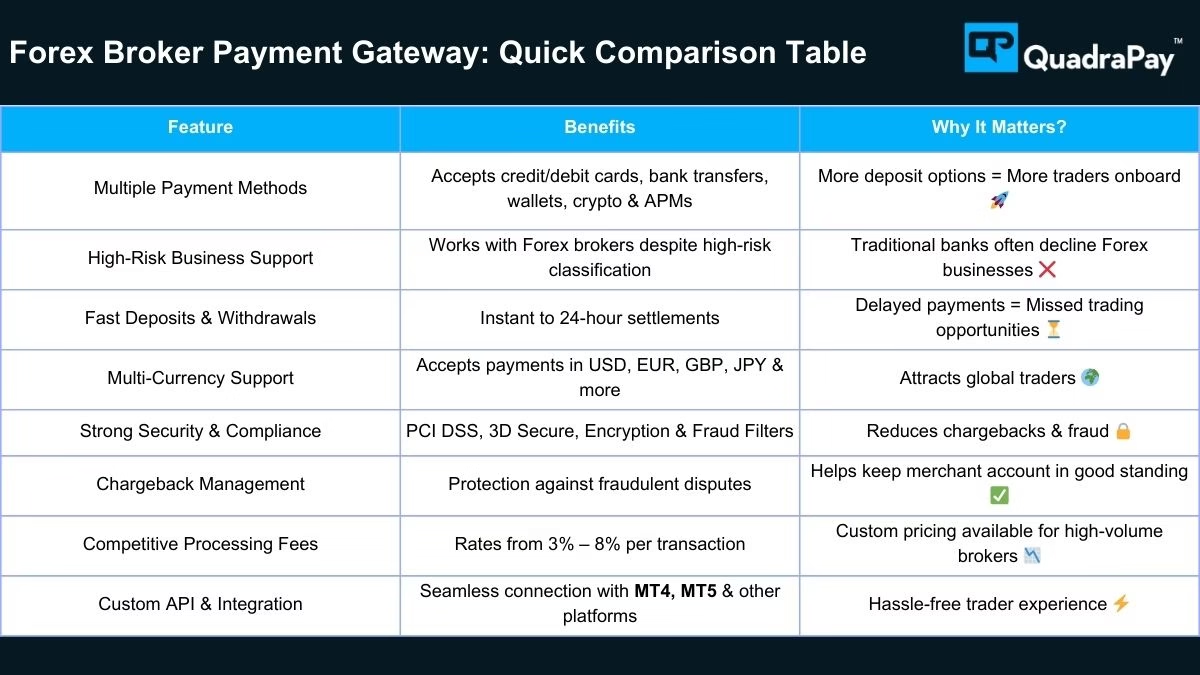
Choosing the right payment gateway for forex brokers involves more than comparing transaction fees. The best solutions combine secure payment processing, flexible payment methods, fast settlements, fraud prevention, and multi-currency support to help brokers deliver a seamless funding experience.
Multiple payment methods
The Forex payments gateway allows traders to make deposits by using various payment methods like bank transfers, credit cards, debit cards, gift cards, wallets, and APMs. The more payment methods you offer to traders, the better the deposit experience they will have.
Security compliance
It is important to ensure transaction security in a high-risk industry like forex. For this, the payment gateway solution must implement robust security protocols like encryption, SSL, AVS, 3DS, PCI DSS checks, two-factor authentication, and fraud filters. All these measures help enhance the security of the account and transaction data.
Quick Deposits and Payout
Delays in deposits and payouts can result in trading delays and potential losses. If you use a solution powered by the finest forex broker payment gateway companies, then you will not face such delays.
Multi-currency processing
Traders prefer to make payments in their home currencies. The payment gateway should accept multiple currencies. Depending on the trader’s location, the amount should automatically be converted into the local currency. This is done by utilizing dynamic currency conversion (DCC) features.
Chargeback & Fraud Prevention
Forex brokers operate in a high-risk environment where fraudulent transactions and chargebacks can affect both revenue and merchant account stability. A reliable forex broker payment gateway should include advanced fraud prevention tools that help identify suspicious activity, reduce payment disputes, and protect both brokers and traders.
Supported Payment Methods for Forex Brokers
Offering multiple payment methods allows forex brokers to serve traders from different countries while improving the overall funding experience. A modern payment gateway for forex brokers should support secure, fast, and flexible payment options that make it easier for traders to deposit funds and request withdrawals. The availability of payment methods may vary depending on your business location, acquiring partner, and regulatory requirements.
| Payment Method | Benefits for Forex Brokers |
|---|---|
| Credit Cards | Instant trader deposits and worldwide acceptance |
| Debit Cards | Quick account funding with familiar payment methods |
| Bank Transfers | Ideal for large domestic and international transactions |
| ACH Payments | Cost-effective bank transfers for supported regions |
| Digital Wallets | Faster deposits and withdrawals with improved convenience |
| Alternative Payment Methods (APMs) | Supports regional payment preferences and increases payment success rates |
Supporting a variety of payment methods helps forex brokers provide a smoother payment experience while reaching traders across different markets. Choosing the right forex broker payment gateway also allows brokerages to expand internationally without limiting customers to a single payment option.
Forex Broker Payment Gateway Rates and Fees
The cost of a forex broker payment gateway depends on several factors, including your processing volume, business location, payment methods, chargeback history, and overall risk profile. Since forex brokers are considered high-risk merchants, pricing may differ from standard payment gateway solutions. Understanding the common fees can help you compare providers and choose the right payment solution for your brokerage.
The fees you will pay for using a Forex broker payment gateway will be slightly higher if you compare it with a low-risk payment gateway. Here we are presenting to you some important fees with tentative rates that you should be prepared to pay if you wish to use a forex broker payment gateway. Keep in mind that, based on the merchant’s risk profile, these rates may be negotiated.
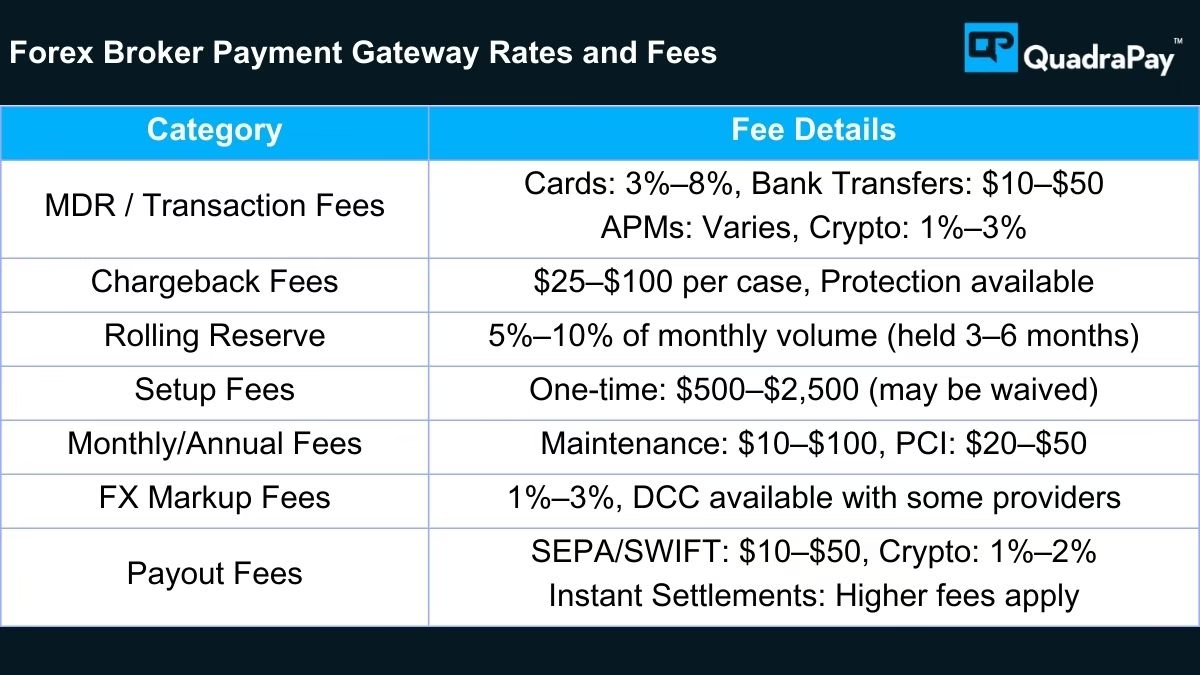
While some fees are fixed, others depend on your brokerage’s processing profile and the acquiring partner’s underwriting requirements. Comparing pricing alongside features such as fraud prevention, multi-currency support, payout speed, and customer support will help you select the best payment gateway for your forex brokerage.
KYC Documents for Forex Broker All-in-One Payment Gateway
Before approving a payment gateway for forex brokers, acquiring banks and payment processors perform a detailed underwriting review. As part of this process, brokers are required to submit business, identity, and compliance documents to verify the legitimacy of their operations and meet regulatory requirements.
Merchant Account Application Form: This form provides an overview of your forex broker company. It includes details such as incorporation information, ownership percentage, expected monthly sales volume, and preferred currencies.
National ID
This is to verify the identity of the business owners. Acceptable photo IDs include passports and driver’s licenses. Keep in mind that in industries like forex trading and proprietary trading, the merchant is required to collect the KYC of all participating traders and brokers. The acquiring bank will share more details about the same.
Business Registration Documents
Proof of business registration may vary depending on your company’s structure and nation of registration. This could include DBAs, LLCs, or a limited company. The proof of business registration can be any document similar to a certificate of incorporation.
Proof of Address
To confirm the physical addresses of directors’ homes and the company, you’ll need to provide a recent utility bill for both addresses. This can be a bill for any of these services, like phone, water, gas, or municipal tax.
Bank Account Details
The payment processor must collect the details of your business bank account. The settlement cannot be made to personal accounts. You can confirm the account details by providing a voided check or a letter from the bank.
AML & Compliance Documentation
Depending on the acquiring partner and jurisdiction, forex brokers may also need to provide AML policies, customer verification procedures, licensing information, and other compliance documents that demonstrate adherence to applicable financial regulations.
Website Compliance for Forex Broker Merchant Accounts
A compliant and professionally maintained website plays an important role in the approval process for a payment gateway for forex brokers. Before approving a merchant account, acquiring banks and payment processors review a brokerage’s website to verify its legitimacy, regulatory disclosures, and payment policies. A transparent website not only improves the chances of approval but also builds trust with prospective traders.
Your website should clearly display your company’s registered business name, address, contact details, and customer support channels. It should also provide detailed information about deposit methods, withdrawal procedures, processing times, applicable fees, and supported payment options so traders understand how payments are handled before opening an account.
In addition to payment information, forex broker websites should include essential legal and compliance pages such as Terms & Conditions, Privacy Policy, AML/KYC Policy, and Risk Disclosure. These pages help demonstrate regulatory compliance while explaining how customer information is handled and outlining the risks associated with forex trading.
Avoid making misleading claims such as guaranteed profits, risk-free trading, or unrealistic earning potential. Your website should also clearly identify the countries or jurisdictions where your services are unavailable due to regulatory restrictions. Providing accurate business information and maintaining transparent policies helps improve credibility with both payment processors and traders.
Forex Broker All-in-One Payment Gateway FAQ
Does QuadraPay Offer Merchant Accounts for Forex Coaching/Training?
Forex trading is gaining popularity worldwide, leading to a growing demand for skilled Forex trainers. If you specialize in providing Forex trading knowledge, it’s essential to have a merchant account. Our processing partners are absolutely fine in evaluating applications from professional forex trading gurus. However, keep in mind that they may require a previous processing history and may only onboard accounts that meet minimum monthly volume criteria.
Where Can I Find the List of Forex Brokers’ Licensing and Regulatory Bodies?
Here is a list of almost every major forex broker licensing and regulatory body from across the world. Keep in mind that our processing partners may not support brokers approved by all the listed regulatory bodies. This list is only for information.
| Country / Region | Forex Regulatory Authority |
|---|---|
| USA | Commodity Futures Trading Commission (CFTC), National Futures Association (NFA) |
| Canada | Investment Industry Regulatory Organization of Canada (IIROC), Canadian Securities Administrators (CSA) |
| United Kingdom | Financial Conduct Authority (FCA) |
| Cyprus | Cyprus Securities and Exchange Commission (CySEC) |
| Malta | Malta Financial Services Authority (MFSA) |
| Italy | Commissione Nazionale per le Società e la Borsa (CONSOB) |
| France | Autorité des Marchés Financiers (AMF) |
| Germany | Federal Financial Supervisory Authority (BaFin) |
| Spain | Comisión Nacional del Mercado de Valores (CNMV) |
| Switzerland | Swiss Financial Market Supervisory Authority (FINMA) |
| Australia | Australian Securities and Investments Commission (ASIC) |
| New Zealand | Financial Markets Authority (FMA) |
| Singapore | Monetary Authority of Singapore (MAS) |
| Hong Kong | Securities and Futures Commission (SFC) |
| Japan | Financial Services Agency (FSA) |
| India | Securities and Exchange Board of India (SEBI) |
| Malaysia | Bank Negara Malaysia & Securities Commission Malaysia (BNM & SCM) |
| UAE | Dubai Financial Services Authority (DFSA), Central Bank of the United Arab Emirates (CBUAE) |
| Saudi Arabia | Capital Markets Authority (CMA) |
| Qatar | Qatar Financial Centre Regulatory Authority (QFCRA) |
| South Africa | Financial Sector Conduct Authority (FSCA) |
| Kenya | Capital Markets Authority (CMA Kenya) |
| Nigeria | Central Bank of Nigeria & Securities and Exchange Commission (CBN & SEC Nigeria) |
| Brazil | Comissão de Valores Mobiliários (CVM) |
| Chile | Superintendencia de Bancos e Instituciones Financieras (SBIF) |
| Colombia | Superintendencia Financiera de Colombia (SFC) |
| Mexico | Comisión Nacional Bancaria y de Valores (CNBV) |
| Seychelles | Financial Services Authority (FSA Seychelles) |
| Belize | International Financial Services Commission (IFSC Belize) |
| Labuan (Malaysia) | Labuan Financial Services Authority (Labuan FSA) |
| Mauritius | Financial Services Commission (FSC Mauritius) |
| Vanuatu | Vanuatu Financial Services Commission (VFSC) |
| St. Vincent & Grenadines | Financial Services Authority (SVG FSA) |
Why Are Forex Brokers Considered High-Risk Merchants?
Forex brokers are generally classified as high-risk businesses because of online trading, cross-border transactions, regulatory requirements, and the potential for chargebacks. As a result, obtaining a forex broker’s payment gateway usually requires additional underwriting, compliance checks, and approval from specialized high-risk payment providers.
Can Forex Brokers Accept International Payments?
Yes. A forex broker’s payment gateway allows brokerages to accept international payments through multiple currencies and payment methods. This helps traders fund their accounts securely while giving brokers access to customers across different countries, subject to regulatory and acquiring partner requirements.
What Should I Look for in the Best Payment Gateway for Forex Brokers?
The best payment gateway for forex brokers should provide secure payment processing, multiple payment methods, multi-currency support, fraud prevention tools, fast settlements, and reliable customer support. Choosing the right forex broker’s payment gateway also depends on your brokerage’s business model, target markets, and compliance requirements.
Can Startup Forex Brokers Apply for a Payment Gateway?
Yes. Startup brokerages can apply for a forex broker’s payment gateway, although approval depends on business registration, website compliance, ownership verification, regulatory status, and underwriting review. A well-prepared application can improve approval prospects.
Can a Forex Broker’s Payment Gateway Support Multiple Currencies?
Yes. Most forex brokers’ payment gateway solutions support multiple currencies, allowing traders to deposit and withdraw funds using their preferred currency. This improves the payment experience for international clients while helping brokerages expand into global markets.
How Long Does Approval Take for a Forex broker’s payment gateway?
Approval timelines vary depending on the acquiring bank, submitted documentation, website compliance, and underwriting requirements. Brokers with complete documentation and a compliant website generally receive faster decisions when applying for a forex broker’s payment gateway.
Forex Brokers Payment Gateway: Conclusion
Choosing the right forex broker’s payment gateway is essential for providing traders with a secure, reliable, and efficient payment experience. From supporting multiple payment methods and currencies to meeting KYC, AML, and website compliance requirements, every aspect of your payment infrastructure plays an important role in the approval process and long-term success of your brokerage. Working with payment providers experienced in high-risk industries can help simplify onboarding while supporting secure payment acceptance for traders worldwide.
At QuadraPay, we work with acquiring partners that understand the payment processing needs of forex brokerages. Whether you’re launching a new brokerage or upgrading your existing payment infrastructure, our team can help you explore forex brokers’ payment gateway solutions tailored to your business requirements.
Ready to Find the Right Forex Brokers Payment Gateway?
Looking for a secure and reliable forex broker’s payment gateway for your brokerage? Contact the QuadraPay team today to discuss your payment processing requirements, explore available solutions, and receive a customized quote based on your business model and processing needs.