
Stable High-Risk Merchant Accounts in Canada
Many high-risk businesses in Canada face difficulties in obtaining approval for merchant accounts. Most low-risk acquirers impose strict requirements, making the process challenging. Some businesses are fortunate to secure a solution after applying to multiple providers. In contrast, others struggle to find any provider willing to approve them. These businesses, even while being legal, face survival challenges.
Here are the seven key challenges that Canadian high-risk merchants frequently face:
| High-Risk Payment Challenges In Canada | Impact |
|---|---|
| Strict Compliance | Complex KYC and PCI requirements |
| High Processing Fees | Higher payment processing costs |
| Limited Processor Options | Fewer willing acquiring partners |
| Chargebacks & Fraud | Disputes and account risk |
| Limited Payment Gateways | Fewer integration options |
| Account Freezes | Payment and cash flow disruption |
| Poor Support | Slower onboarding and resolution |
What is a high-risk merchant account in Canada?
A high-risk merchant account in Canada is a specialized bank account for businesses classified as high-risk by banks. It allows them to accept credit card payments. These accounts function like regular merchant accounts but come with key differences. Underwriting is stricter, rates are slightly higher, and proactive monitoring is required. Certain restrictions apply based on the industry and the merchant’s risk profile.
Why are some merchants considered high risk in Canada?
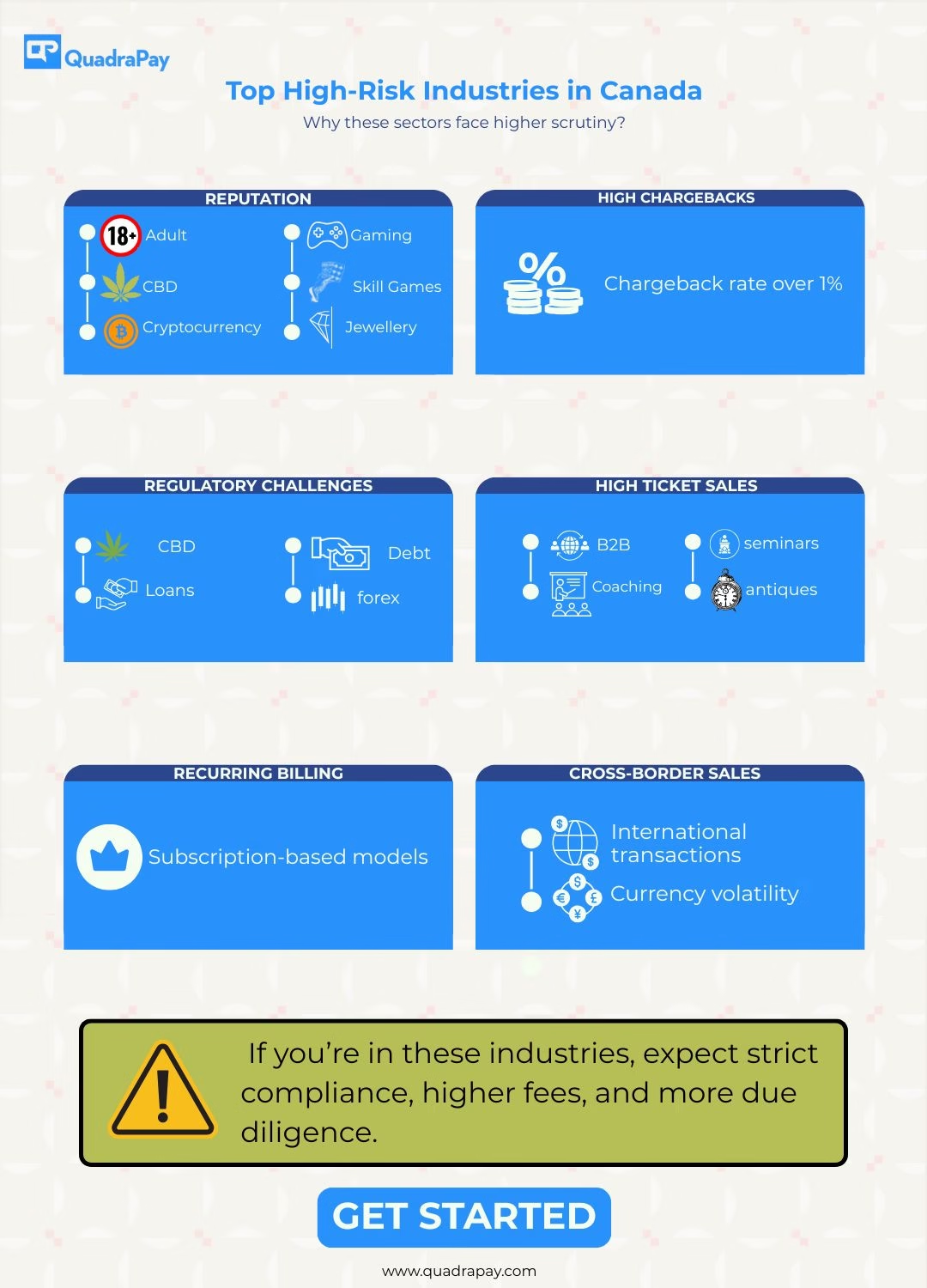
Banking institutions have their own style of operations. They choose which industries to work in and which to avoid. Every bank has its own risk appetite. Certain industries are legal but are considered high-risk. In Canada, specialized high-risk processors cater to merchants from high-risk industries. Below are the key reasons why Canadian businesses are often labelled as high risk by acquiring banks and payment processors:
| Merchant Account Risk Factor | Why It Matters |
|---|---|
| Industry Reputation | Higher perceived industry risk |
| High Chargebacks | Elevated dispute risk |
| Legal Restrictions | Complex regulatory requirements |
| High Ticket Size | Higher transaction exposure |
| Recurring Billing | More cancellations and disputes |
| Cross-Border Transactions | Fraud and currency risks |
| No Processing History | Limited underwriting data |
A few of the key reasons that make a Canadian business high risk include the reputation of the industry, the risk of chargebacks, and regulatory challenges. Now let’s explore various such reasons in detail.
Industry
Certain industries are globally classified as high-risk. These merchants can get card processing solutions after a strict evaluation. They may also need to complete a mandatory high-risk registration. Every high-risk industry has some challenges associated with credit and reputational risk. The list below includes some examples.
Antiques & Collectibles businesses sell items that can attract frequent disputes. These disputes may arise due to pricing, item conditions, and questions about authenticity. Customers may feel they paid more than the product was worth, increasing the risk of chargebacks. This industry is also infamous because of fraudulent buyers. Sometimes fraudsters use stolen credit cards to purchase high-value antique items. All this makes Canadian antiques and collectible businesses high risk for acquiring banks.
The clothing business may look like a very secure industry. However, in reality, it involves a lot of risk for acquirers. Recently, the apparel industry has started seeing high rates of returns and exchanges. Occasionally, such returns may be due to issues with sizes or colours. These issues contribute to the merchant’s financial instability. Any boutique that sees the seasonal spike in sales can create fluctuating cash flow. These conditions can lead to higher credit risk for the acquiring bank when customers start asking for refunds.
The challenge faced by cannabis and hemp-related businesses is that their legal status varies across regions. Some jurisdictions allow such businesses with restrictions, whereas others prohibit them. The challenge for these merchants increases when they encounter difficulties in obtaining a merchant account. Processors believe cannabis-related businesses face regulatory challenges. Such situations can result in inconsistent banking relations because of federal or provincial laws.
CBD products are widely available in Canada. Every Canadian CBD entrepreneur is aware of the legal uncertainties surrounding this industry. The industry may be legal, but it is highly regulated, and restrictions do apply. The complex structure makes it difficult for processors to support CBD oil merchants.
Similar to industries such as CBD, the gaming industry also faces significant challenges due to the varying legal landscapes. Furthermore, gambling merchants generally deal with large sums of money, which can make them a potential target of fraud. Gambling is regulated in most jurisdictions. Payment service providers that support this industry must know the regulations for the merchant’s home location and the location where they expect traffic from.
High Chargeback
If a merchant gets above the normal chargebacks, then that merchant becomes a liability for the processor. Businesses need to ensure that the chargeback ratio always stays under 1%. They can take several steps to keep chargebacks below the threshold.
High Ticket Size
Certain industries have more than the average ticket size. Their monthly sales volume is multiple times that of merchants from low-risk industries. Some examples include gaming, gambling, exports/imports, B2B, jewellery, coaching, seminars, crypto trading, forex trading, and betting advice merchants. All these industries are naturally high risk because of the ticket size and high monthly sales volume.
Chargeback Prevention Strategies for Canadian High-Risk E-commerce Merchants
| Chargeback Prevention Strategy | Purpose |
|---|---|
| Clear Refund Policy | Reduce refund disputes |
| Fraud Detection Tools | Detect fraud using AVS and CVV |
| Order Confirmations | Confirm orders and delivery details |
| Customer Support | Resolve issues before disputes |
| Chargeback Alerts | Identify disputes early |
| Recurring Billing Transparency | Reduce subscription disputes |
| Product Descriptions | Set accurate customer expectations |
| Delivery Tracking | Provide proof of delivery |
| Billing Descriptors | Reduce transaction confusion |
| Dispute Resolution | Direct complaints to merchant support |
Features of high-risk credit card processing accounts in Canada
Canadian businesses need to consider several factors when selecting a high-risk merchant processor. We have listed some of these factors here:
High-Risk PSP: Not every payment processor works with high-risk merchants. Some high-risk merchants in select industries can only be onboarded by specialized payment processors. In the payment industry, these processors are also known as high-risk processors.
Experience: It is important to ensure that the payment processor has enough experience assisting merchants from the region. A seasoned high-risk payment facilitator operating in Canada or the USA may be a viable option.
Multiple Payment Methods: Merchants should prefer a provider that allows them to accept various payment methods. By adding multiple payment methods to the checkout page, merchants increase the chances of transaction success.
Affordability: Pricing should be reasonable, and as an informed merchant, you should be aware that in the payment industry, pricing comes in different types: fixed pricing and interchange pricing. A little bit of research on these pricing models can help merchants negotiate better deals.
Fast Settlement Cycle: Most high-risk payment processors in Canada offer a rapid settlement cycle. This process helps ensure better business operations because of healthy cash flow.
Easy Integration: Integration with your website or platform must be straightforward. Your payment processor should provide ready-to-use plugins for popular content management platforms in Canada, like Shopify, Wix, BigCommerce, etc. The payment processor should also provide detailed API information for custom integration.
Advanced Merchant Panel: The merchant panel should be easy to use. It should have functions for exporting records and uploading chargeback representment documents.
KYC for High-Risk Merchant Accounts in Canada
To get a high-risk credit card processing account for your business in Canada, you must submit certain KYC documents. Let’s look at some of the documents that you will have to send to the provider:
| Canada Merchant Account Document | Purpose |
|---|---|
| Business Registration | Verify Canadian business registration |
| Government ID | Verify owners or directors |
| Proof of Address | Confirm business or owner address |
| Processing Statements | Review 3–6 months of processing |
| Bank Statements | Review recent business banking |
The business registration certificate, AOA, and MOA are required to verify the business entity. Merchants with any of the following business structures can apply for an account: sole proprietorship, partnership, limited partnership (LP), corporation, limited liability partnership (LLP), not-for-profit organization, and trust.
For identification purposes, you can send a copy of your national ID, passport, or driver’s license.
To confirm the company’s physical address, utility bills are required, and this can be a telephone, gas, or electricity bill.
To further assess your business’s financial stability, statements from the past three months of your business bank account are required. This financial documentation provides insights into your business’s cash flow and financial health.
Your previous statements for credit card processing play a positive role in getting your account approved. High-risk acquiring banks prefer to work with businesses that already have experience accepting credit card payments.
Application Process for High-Risk Payment Processing Account in Canada
The application process is simple. You start with research and apply to a few select providers. However, this process can be time-consuming. With QuadraPay, you can save a lot of time, as we have already established contacts with well-known high-risk processors. We are a reseller, and our service allows you to negotiate directly with processors. If you choose our recommended solution, then we may receive a commission. You can consider it a reward for all the legwork we put in to get you approved.
The application process is very simple; all you have to do is start with research and apply to a few select providers. However, this process can be time-consuming. With QuadraPay, you can save a lot of time, as we have already established contacts with well-known high-risk processors. We are a reseller, and our service allows you to negotiate directly with processors. If you choose our recommended solution, then we may receive a commission. You can consider it a reward for all the legwork we put in to get you approved.
Canada Payment Processing FAQs
What Is the Approval Timeline for a High-Risk Payment Gateway in Canada?
Many factors influence the approval timeframe; however, most accounts are approved in a week’s time. It’s important to apply strategically rather than sending applications to all banks and payment service providers, as this approach may delay approvals and create an unfavourable impression. Below is a general breakdown of the high-risk merchant account approval timeline in Canada:
| Merchant Account Stage | Typical Timeframe |
|---|---|
| Application Submission | 1–2 days |
| Underwriting Review | 3–5 days |
| Account Setup | 1–2 days |
| Go Live | After approval and setup |
What payment methods do consumers in Canada prefer?
Canadians mainly rely on credit cards when purchasing items from both online platforms and physical stores, making Canada among the countries with some of the highest use of credit card payments worldwide. Debit cards are another means through which Canadians purchase items from online sites and physical stores. Digital payment modes like Apple Pay, Google Pay, and PayPal are also being used increasingly by Canadians. Furthermore, Buy Now Pay Later options and account-to-account payments are gaining acceptance among Canadians as well.
Businesses targeting Canadians would be advised to offer various payment options to meet consumer preferences. Offering various payment modes can enhance conversion performance and improve authorization success rates while lowering instances of abandonment of shopping carts. Businesses that wish to expand their operations into the Canadian market would benefit greatly from a Canada Merchant Account, Payment Gateway Canada, and solutions that enable them to Accept Payments in Canada.
What payment methods should e-commerce businesses offer in Canada?
For effective online sales in Canada, it is necessary for e-commerce enterprises to ensure that they have a wide variety of payment solutions which will cater to the needs of local consumers.
Commonly used payment solutions in Canada include credit/debit cards, Interac, PayPal, Apple Pay, Google Pay, Buy Now Pay Later services, debit cards, and credit card payment solutions. The Canadian shoppers are flexible, convenient, and secure during online shopping; hence, e-commerce firms need to offer varied trusted payment solutions at checkout.
Localization of the payment process plays an integral part in increasing the trust level and decreasing the cart abandonment rate for consumers. With support for varied payment solutions such as debit, credit, and Buy Now Pay Later payment solutions, merchants will be able to make online shopping more comfortable for shoppers. The merchants can enhance the payment processing infrastructure through a robust Canada Payment Gateway, E-commerce Payment Processing, and Online Merchant Account solution.
What is Interac and why should merchants accept it?
Interac is Canada’s domestic payment network system. It is known to be one of the most reputable financial companies in the country. Consumers widely use it for their debit card payments and, even more recently, for their account-to-account transaction experiences, therefore playing an essential role in Canada’s payment ecosystem.
Due to the wide usage of Interac by Canadians, it is perceived as being a safe and trusted payment solution for people both when using it in physical stores and on online platforms.
To better serve their Canadian customers, businesses may find it helpful to accept Interac payments as a more localized payment solution. It allows businesses to gain additional payment opportunities by using the Interac Payment Processing solutions, the full-spectrum Canada Merchant Services, and several other Alternative Payment Methods.
Are digital wallets popular in Canada?
Yes. Digital wallets are becoming increasingly popular in Canada. They are now widely used for online shopping, mobile commerce, and contactless in-store purchases.
Canadian consumers frequently use Apple Pay, Google Pay, and PayPal because they offer a fast, secure, and convenient way to complete transactions. As smartphone usage and contactless payment adoption continue to grow, digital wallets are playing a larger role in both e-commerce and retail environments.
For businesses, supporting digital wallets can help streamline the checkout process, reduce payment friction, and improve the overall customer experience. Faster checkout experiences are particularly valuable for mobile shoppers and can help increase conversion rates while reducing cart abandonment.
Companies can support these evolving payment preferences through Digital Wallet Payment Processing, advanced Mobile Payment Solutions, and Contactless Payments that enable seamless transactions across online and in-store channels.
Is Canada a strong market for Buy Now Pay Later (BNPL)?
Yes. Canada is a strong and growing market for Buy Now Pay Later (BNPL) solutions. BNPL adoption continues to increase across sectors such as retail, electronics, furniture, travel, fashion, and lifestyle products as consumers look for more flexible ways to manage their purchases. Providers such as Klarna, Affirm, and Afterpay have helped make installment payments a popular option among Canadian shoppers.
For merchants, offering BNPL can help reduce purchase hesitation, improve conversion rates, and increase average order values. Flexible payment options can also enhance the customer experience by giving shoppers more control over how and when they pay. Businesses can support this growing demand through BNPL Payment Solutions, a dedicated Retail Merchant Account, and Consumer Financing Solutions that provide customers with convenient and flexible payment choices.
Is Canada a good market for SaaS and subscription businesses?
Indeed, Canada is an interesting target market for software as a service, subscriptions, memberships, streamings, and other digital product providers. The country boasts an advanced digital economy with a widespread presence of recurring billing services, allowing customers to use subscription-based solutions and make recurring payments easily.
For any business wishing to enter the Canadian market, it is advisable to consider introducing customers to the option of recurring payments and using digital wallets and other convenient check-out methods. In turn, a smooth payment process may positively affect the process of acquiring customers, lowering payment failure rates, and even helping in retaining more customers.
A company could benefit from implementing such payment technologies as SaaS Merchant Account, Subscription Billing Solutions, and Recurring Payment Processing.
Are account-to-account (A2A) payments growing in Canada?
Yes, A2A payment is becoming increasingly popular in Canada as the country continues to modernize its payment ecosystem, offering an array of real-time payment features. With current innovations in payment technology at banks and developments in relation to the Interac payment system, A2A payments are likely to be used more frequently in the future in various sectors, including e-commerce, subscriptions, banking, and business-to-business transactions.
The implementation of A2A payments can give merchants certain advantages. First, it could help them make settlements within a shorter period; next, it would enhance payment efficiency; lastly, they would not have to depend upon existing card systems. As Canadians become more aware of real-time and bank-based payment opportunities, companies that provide such means will likely succeed in meeting the demands of their customers. There are several A2A payment-related resources merchants could employ, such as Open Banking Payments, A2A Payment Processing, and Real-Time Payments.
Can high-risk businesses obtain payment processing in Canada?
Yes, there is indeed an opportunity for many high-risk industries to receive payment processing services in Canada if they meet certain criteria and are approved through underwriting. Some key aspects assessed when approving high-risk merchants may include the type of business model, their transactional history, volumes processed, chargebacks, etc.
In any case, a properly constructed payment structure will make it possible to increase the probability of approval, reduce chargebacks, ensure the maximum possible number of successful transactions, and achieve stable operation in the future.
A comprehensive payment system for such companies may include, among others, efficient fraud protection, risk management and optimized payment methods. In this regard, it makes sense to use the services of the following types of accounts: High-Risk Merchant Account Canada, Gaming Merchant Account, Forex Merchant Account, and Travel Merchant Account.
Why is Canada an attractive market for gaming, fintech, and digital businesses?
Canada represents a highly favorable market for gaming, fintech, and digital enterprises owing to a combination of the country’s large consumer population, widespread digital awareness among consumers, the popularity of credit cards, an advanced banking system, and the rising use of digital payment solutions. The consumers of Canada are quite ready to conduct online purchases, subscribe to various digital services, and use unique payment methods.
The above-mentioned factors offer a wide array of opportunities for gaming operators, fintech enterprises, software firms, digital entities, SaaS, and subscription companies to grow and prosper in Canada. A mature financial system, coupled with high consumer confidence in digital payments, enables such organizations to generate high transaction volume and maintain customers.
Those firms interested in entering the market may enhance their payment solutions by using a Gaming Merchant Account, a dedicated Fintech Merchant Account, and Digital Services Payment Processing options.
How can international businesses increase online sales in Canada?
Online transactions can be boosted in Canada by offering customers an experience where they find it easy and convenient to use the various forms of payment that suit their preferences. The provision of things like the acceptance of the leading card providers, the use of digital wallets, recurring payment options, and Buy Now Pay Later services would make the payment process much better.
The checkout process on mobile devices needs to be optimized since more people are making online purchases through their phones. A smooth and effective checkout process will increase conversions and reduce abandonment rate. Companies expanding their activities into Canada should invest in setting up a strong system for handling different payments, and this can be done by setting up an International Merchant Account, a Canada Payment Gateway, and Cross-Border Payment Processing systems.
Why is payment localization important when selling to customers in Canada?
Payment localization is crucial if you are trying to reach Canadian consumers, since consumers are extremely confident with payment solutions they are used to, like credit cards, Interac, and preferred digital wallets. If you provide consumers with the opportunity to pay with something that they know and are comfortable with, you will provide them with a much more positive checkout experience.
It may become a decisive factor in whether they are going to buy your products or not. Local Payment Methods combined with checkout localization can help you boost consumer confidence, increase authorizations, avoid checkout abandonment, and generally enhance the shopping experience on both desktops and mobile devices.
Your company can benefit greatly from payment localization as you will be able to reach out to more potential customers and convert as many leads as possible. Your company can also explore the full range of North America Payment Processing and International Expansion Solutions to expand its business throughout the entire country.
What is the best payment gateway for businesses targeting Canada?
A suitable Canadian payment gateway should include support for payment cards that are widely accepted within Canada. For instance, the payment gateway should allow customers to pay using their credit debit cards.
The payment gateway should also feature Interac, digital wallet support, recurring payments, buy now and pay later solutions, fraud detection and prevention services, and multi-currency options. Canadian consumers demand a safe, seamless, and easy-to-use payment experience. It makes a payment gateway with such capabilities very important in optimizing conversion rates.
Companies operating in Canada or those interested in doing business in the country would find it prudent to consider the Canada Payment Gateway. This payment gateway solution provides support for domestic and international transactions by ensuring customers can pay using their preferred payment methods.